
Easily calculate your Tamil Nadu electricity bill online using the TNEB bill calculator. This tool provides accurate LA1A tariff charges, a clear slab-wise breakdown, and instant results, helping households monitor usage, budget efficiently, and avoid surprises in their electricity bills.
About the TNEB Bill Calculator
The TNEB bill calculator is specifically designed for domestic households in Tamil Nadu using the LA1A tariff category under the Tamil Nadu Generation and Distribution Corporation Limited (TANGEDCO) / Tamil Nadu Electricity Regulatory Commission (TNERC)-approved structure.
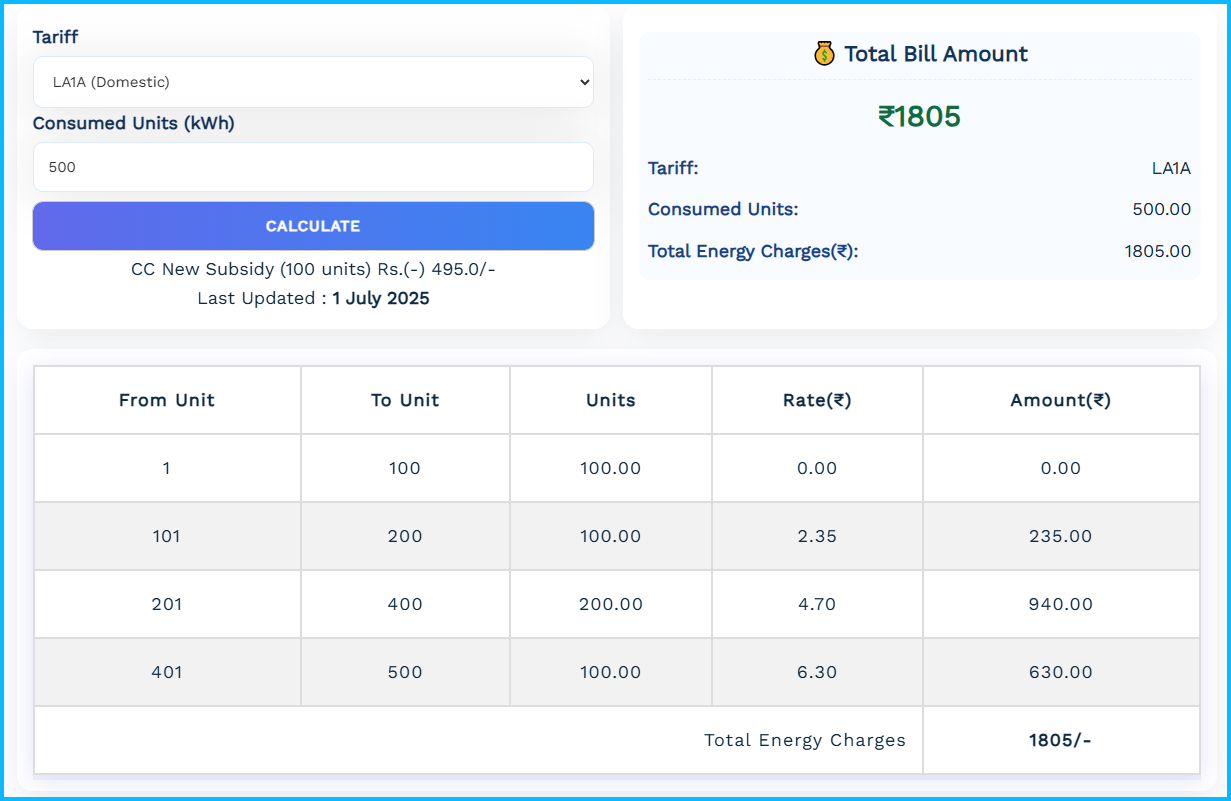
It estimates your electricity bill instantly, showing a slab-wise breakdown of units consumed and the charges applied.
Why Use This TNEB bill calculator?
Using a dedicated TNEB bill calculator helps you:
- Understand your bill — know exactly how many units you consumed and how each slab is charged.
- Budget smarter — see your expected bill amount ahead of time and plan accordingly.
- Monitor usage — identify whether you are crossing into higher‑rate slabs and adjust your consumption habits.
- Transparent breakdown — the calculator provides a clear slab‑wise view so you’re not surprised when your bill arrives.
Key Features of the TNEB Bill Calculator
- Supports the LA1A Domestic Tariff category (for households) across Tamil Nadu.
- Slab rates updated as per the latest orders (effective from 1 July 2025).
- Mobile-friendly and responsive UI for any device.
- Instant calculation – no waiting, no hidden fees.
- Slab-wise table display to track exactly how your bill is composed.
Understanding the Tariff Structure with the TNEB Bill Calculator
Domestic electricity under LA1A uses a progressive slab system. The more units you consume, the higher the rate for additional units.
This ensures affordability at lower usage levels and moderates excessive energy consumption.
Latest Slab Rates (From 1 July 2025)
Here is the breakdown of units and per‑unit charges for domestic users (LA1A):
| Units (bi‑monthly) * | Slab Range | Rate (₹/unit) |
|---|---|---|
| 1‑100 | First 100 units | ₹ 0.00 |
| 101‑200 | Next 100 units | ₹ 2.35 |
| 201‑400 | Next 200 units | ₹ 4.70 |
| 401‑500 | Next 100 units | ₹ 6.30 |
| 501‑600 | Next 100 units | ₹ 8.40 |
| 601‑800 | Next 200 units | ₹ 9.45 |
| 801‑1000 | Next 200 units | ₹ 10.50 |
| 1001 & above | Units above 1000 | ₹ 11.55 |
*Bi-monthly billing is standard in Tamil Nadu.
How Slab Rates Work – Example
Suppose you consume 650 units in a two-month period. The TNEB bill calculator would compute:
- First 100 units → 100 × ₹ 0.00 = ₹ 0.00
- Next 100 units (101‑200) → 100 × ₹ 2.35 = ₹ 235.00
- Next 200 units (201‑400) → 200 × ₹ 4.70 = ₹ 940.00
- Next 100 units (401‑500) → 100 × ₹ 6.30 = ₹ 630.00
- Remaining 150 units (501‑650) → 150 × ₹ 8.40 = ₹ 1,260.00
Total energy charges ≈ ₹3,065 (before fixed charges, taxes, or subsidies). Plug these units into our TNEB bill calculator to get a fully rounded net amount.
Why the Rate Jumps After 500 Units
Rates increase in higher slabs (501–600 units and above) to encourage energy conservation and cover higher supply costs.
For example, rates jump to ₹8.40 at 501–600 units and ₹10.50 at 801–1000 units. The TNEB bill calculator automatically applies these rates.
How to Use the TNEB Bill Calculator (Step‑by‑Step)
Follow these simple steps:
- Select your tariff category (by default LA1A – Domestic). If you are using commercial or industrial connection, contact your utility or see alternate calculators.
- Enter units consumed in kWh (e.g., 350).
- Click “Calculate Bill” – the TNEB bill calculator shows slab-wise units, rate, and amount.
- Scroll to view the detailed table.
- Check the summary box for the rounded net amount to plan your budget.
Tips to Reduce Your Electricity Bill Using the TNEB Bill Calculator
Here are some practical tips for households in Tamil Nadu to reduce power consumption and save on your monthly bill:
- Switch to LED bulbs – up to 80% less energy.
- Run appliances with full loads and at off-peak hours.
- Set ACs to 24–26 °C and clean filters regularly.
- Unplug idle devices to avoid phantom power.
- Use ceiling fans or natural ventilation when possible.
- Record meter readings and compare with previous bills.
- Improve insulation and sealing of windows/doors to reduce AC load.
Frequently Asked Questions About the TNEB Bill Calculator
1. What does “LA1A Domestic Tariff” mean?
“LA1A” is the tariff category used by TANGEDCO/TNEB for domestic supply to households in Tamil Nadu. It is one of the common categories for single‑meter residential connections and covers lighting, fans, household appliances, etc.
2. Is the first 100 units truly free?
Yes — as per the latest tariff revision, for LA1A domestic connections the first 100 units in a bi‑monthly cycle are charged at ₹ 0.00/‑ (free). That means you pay nothing for the first 100 kWh consumed in that period.
3. Why does my bill suddenly increase when I cross a slab boundary?
Because the slab system is progressive, crossing into a higher slab rate means the additional units are charged at a higher per‑unit rate. Even a few extra units can push you into the next slab.
For example, crossing 500 units means the next units may attract ₹ 8.40 or higher per unit instead of ₹ 6.30. It’s important to monitor usage especially near slab boundaries.
4. Why do I see a difference between monthly and bi‑monthly consumption bills?
In Tamil Nadu, many domestic bills are for a two‑month (bi‑monthly) cycle, which means your “units” figure covers ~60 days. If the reading period is shorter or longer due to meter reading delays, your bill may differ.
Always check the meter reading dates. Some sources note that monthly cycles may have different applicable slab rates.
5. Are there subsidies applied on my bill?
Yes — the government of Tamil Nadu provides subsidies and encourages lower consumption. For example, first 100 units being free is a subsidy mechanism.
Additional subsidies may apply for certain consumer categories such as huts, old‑age homes, etc.
Always check your bill for subsidy lines.
6. What about fixed charges, taxes and other surcharges?
This calculator focuses on energy charges (units consumed × per‑unit rate). Your actual bill may also have fixed charges (connection/contract charges), meter rent, late fees, taxes (GST or local levies) and other line items.
For an estimate, this tool gives you the bulk of the bill. Always check your actual bill for full details.
Comparing Your Estimate With Actual Bill
When your actual electricity bill arrives from Tamil Nadu Generation and Distribution Corporation Limited (TANGEDCO), compare it with the calculated amount from this tool. Here’s how:
- Check the “units consumed” field on your bill and ensure it matches your meter readings.
- Use those units in the calculator to see the expected “energy charge”.
- Check the slab‑wise table and confirm all slabs used by the meter reading are covered properly.
- Check your bill’s fixed charges, taxes and other surcharges; compare them with estimates or last bill for consistency.
- If your actual bill is significantly higher than the estimate, ask your utility for an explanation (meter reading date, power factor, additional surcharges, or possible mis‑metering). Your calculator gives you a benchmark to challenge if needed.
Why the First 100 Units Are Free
The policy to provide the first 100 units at zero charge is part of the Tamil Nadu government’s social welfare measure. It helps low‑usage households (especially in rural areas) by covering basic lighting and fan usage without cost.
By doing so, the policy aims to support energy access, while the successive slabs ensure that heavier users share more of the cost burden.
Conclusion
Using this TNEB Bill calculator for your domestic connection under LA1A tariff is a smart and proactive step. It empowers you to:
- Estimate your bill ahead of time rather than waiting for surprise arrival.
- Understand how your consumption is charged and what parts of the bill you can control.
- Stay within lower slabs, reduce overall bill, and advocate for fair billing if you see discrepancies.
Remember: **Knowledge is power** — when you know how your bill is built, you’re in a stronger position to manage your usage and costs.
Use this TNEB bill calculator tool, monitor your consumption, and if needed, raise queries with your utility about reading accuracy or unexplained bills.
Good luck and happy saving!